


Every spring, journalism and yearbook students across the country sign up for the annual Journalism Education Association (JEA)/National Scholastic Press Association (NSPA) National High School Journalism Convention (NHSJC), with the events averaging over 5,000 students every convention. This year’s spring convention will be held in Minneapolis, Minnesota, a city that has recently been the subject of considerable controversy.
On Jan. 7, Renée Good, a 37-year-old American citizen, was shot by an Immigration and Customs Enforcement (ICE) officer three times, killing her, before her car ran into a pole. This event occurred in Minneapolis, just seven minutes away from Roosevelt High School, where six hours after the fatal shooting, ICE officers then surrounded the high school, waiting for dismissal.
Due to these events, Laura Widmer, NSPA Executive Director, Veronica Purvis, JEA Executive Director, and Kathryn Campbell, local committee chair in Minneapolis, sent out a joint email to advisers of recurring schools at the spring convention to reassure them that it’s safe to attend.
“We want to be proactive about anticipating [the advisers and students] needs and concerns,” Purvis said. “As the parent of a high school student, I understand the concerns parents may have anytime their children travel for a school activity. I understand why many may not want to take the risk. In light of the current issues, we are continuously discussing the safety status and communicating as much of the security updates and protocols as possible.”
Despite ICE’s presence in almost every state across the country, Minneapolis has been a main focal point for the news. On Jan. 24, Alex Pretti, a 37-year-old registered nurse, was shot by ICE multiple times while trying to assist another citizen who was pushed over during an ICE operation.
“The perspective from then to now on the ICE presence in town is significant, and I believe that will be true six weeks from now, too,” Campbell said. “While I cannot predict when all this will end, it’s my belief that the risk factors we’re attending to now will feel like a lifetime ago in April.”
At the start of the school year, Roosevelt High School in Minneapolis restarted its journalism program with four students and an adviser. Olive Maly, junior at Roosevelt High School, is one of the Co-Editors-in-Chief for the Roosevelt Standard news website and witnessed the events that unfolded at the high school.
“This [situation] sparked enraging fear and a sense of surrealness, seeing your own community being threatened, hurt, and dismantled while being broadcast and captured on the news,” Maly said. “These officers engaged in contentious arrests outside our high school, eventually detaining a staffer, using chemical irritants on students and bystanders, and later prompting a district-wide school closure.”
Thora Anderson, junior at Roosevelt High School, is one of the editors for the Roosevelt Standard.
“After ICE visited Roosevelt, school was canceled for two days. Even once school returned back in session, hundreds of students stayed home. They no longer felt safe to leave their houses and come to school,” Anderson said. “This government operation is preventing kids from getting their education at a public school. The inspiring part, amongst all of this, is how the Roosevelt community stepped up to take care of one another. Whether it is fundraising and collecting donations for community members in need or having community members stand guard after school, we continue to care for one another.”
Lila Dominguez, junior at Roosevelt High School, is the second Co-Editor-in-Chief for the Roosevelt Standard. The same day of the incident, Dominguez wrote an article from her perspective on what happened at school.
“Being afraid to go to school is something no child should endure,” Dominguez said. “The fact that the fear is being caused by our own government adds another layer.”
Signe Boler, junior at Roosevelt High School, is the third Co-Editor-in-Chief for the Roosevelt Standard.
“This experience has made me realize that student voices are extremely important, especially when dealing with a crisis that impacts the younger generations,” Boler said. “With ICE being on school grounds, students, of course, were outraged. Hearing what their peers think definitely helps people feel connected and see eye to eye on things. Student journalism also creates an immense sense of community from the directly impacted group of people. I’ve always valued student opinion and journalism, but this terrible event has made everything so much more real and raw.”
In the following days, the school and its students took steps to make changes. A walkout was held shortly after, and the school offered online learning. The school also provided classes to students on their legal rights and what to do in the case ICE were to be a problem again.
“After our school experienced such violence and hostility, our community grew closer instead of pulling apart,” Maly said. “The week after the incident, the student union led a successful walkout that drew widespread attention and showed our unity. [Also], students like [Boler] and [Dominguez] stepped up, organizing food and necessities for families in need. All of this shows that in moments of adversity, a community’s strongest and most compassionate qualities will always rise to the surface.”
While the events in Minneapolis deeply impacted students living in the city, the situation has also prompted reflection among high school journalism students who are considering traveling to Minneapolis for the national convention.
Schools from across the country, as well as internationally, get together to come to these events. Some states, like Oregon, have faced similar challenges to Minneapolis. The day after Good was shot, two Venezuelan immigrants, Luis David Nino-Moncada and Yorlenys Betzabeth Zambrano-Contreras were shot in Portland in their cars. This occurrence, in particular, left a major impact on Oregonians.
In Oregon, these events have fueled conversation among student journalists about how national tension intersects with local experience. For Sam Smallwood, senior at Sandy High School and a part of both the school’s newspaper and yearbook staff, the decision to attend the spring convention has been shaped more by opportunities than by concerns for the city’s political climate.
“I went to the national convention last year, and it was a blast,” Smallwood said. “I’ve never been to Minnesota, so it’s an incentive to check out a new state.”
While recent headlines have focused heavily on federal law enforcement activity in Minneapolis, safety has not been a defining factor for Smallwood’s thinking.
“I haven’t really thought about Minneapolis being an ‘unsafe’ place,” Smallwood said. “Bad things happen everywhere, every day. That doesn’t necessarily make those places bad.”
Living near Portland, a city that has also experienced high-profile protests and ICE activity, proximity to similar events has influenced how Smallwood interprets the news.
“I don’t see places like Portland or Minneapolis as being unsafe,” Smallwood said. “I see them as places with a lot of things to fix and make right.”
Tara Johnson-Medinger, the yearbook and newspaper adviser at Roosevelt High School in Portland, Oregon, went to the last spring convention in Seattle, Washington.
“We are very transparent with our families and our students and are definitely monitoring the situation that’s happening in Minneapolis,” Johnson-Medinger said. “We do not want to put our students in any type of harm’s way, and we want to make sure that this event is very positive. We recognize that there’s a lot going on in Minneapolis, that is a city under a lot of stress and violence right now, and we have just sent out information to our parents. We’re going to have a parent meeting to discuss and address any questions that they may have. We’re also actively looking at what is happening in the city and where things are located. Mostly peaceful protests have been happening in the city that are not next to where we’ll be attending the conference. We want to be mindful and just monitor the situation. Ultimately, the decision lies in the hands of the families and what’s best for their students. We honor that decision, regardless of what they decide.”
Akshay Shah, sophomore, is planning on going to Minneapolis for his first journalism convention, after being encouraged to attend by his adviser, Glenn Krake.
“[These events] definitely played a large role [in my decision],” Shah said. “My family had talked about it and kind of decided, after what Krake was saying today about the fact that we won’t be in those areas and [it] won’t be a big deal, [and] reassured the fact that it’s not a convenient issue. At the end of the day, it didn’t end up playing as large a role as I thought it would.”
For Shah, however, the conversation extends beyond whether or not students attend—it also raises questions about how national events are covered and whose voices are centered.
Graphic by Iris Hochstettler and Garrett Arendt
“[We should talk] about it more from the angle of the students and how they feel, because I feel like that’s very underrepresented on the actual news, and it’s very much about how it’s impacting the city overall, rather than the people,” Shah said. “I think that it loses the human touch of when someone dies, and it gets very glossed over, in my opinion, and you don’t feel the same justice as if you talk about the actual experience of someone who’s close to them, or something similar to that. I think that, as students, we can go further into that emotional feeling. And I feel the actual news should do that too, but at the same time, be clear about what is really going on, versus the actual political feelings that you feel on the news.”
Rather than avoiding cities under national watch, Smallwood emphasized awareness and personal responsibility, as Minneapolis continues to sit at the center of a broader national conversation surrounding federal immigration enforcement, public response, and the role of media coverage.
“You have to be a wise person and gauge your surroundings,” Smallwood said. “Be smart about where you’re going and when you’re going.”
For Johnson-Medinger, misinformation can often shape public perception more than lived experience.
“I’ve received phone calls from family members outside of Portland expressing concern about what is happening in Portland, because there’s a lot of misinformation about what is actually happening in our communities, and news sources are grabbing on to certain events that they tend to highlight that bring [a] negative connotation to Portland and what is actually happening here,” Johnson-Medinger said. “But personally, I felt very safe in this town. I love my community. I love my school community. I feel very safe. I’m also a privileged, white, middle-aged woman who can exist in this community with a great deal of security. Not everyone has that experience, and so we have to be mindful of other folks’ experiences and safety, and be able to step up and provide support to our students and to our community members. Portland is fantastic, filled with an immense amount of wonderful people. Roosevelt is a wonderful, diverse school, and I’m excited to come here and work every day.”
For Smallwood, journalism still remains the primary motivation for attending the convention. As a feature editor who has recently expanded into sports photography, he said the chance to learn directly from professionals outweighs the uncertainty surrounding the host city.
“It’s my main factor,” Smallwood said. “Anything I can incorporate from people I meet there and get connected with, I think will boost my performance and quality.”
Beyond individual decisions, advisers also hope the convention itself will provide space for discussion and learning surrounding these events.
“I hope that students, prior to us going, [will] talk more about [current events]. We [stay] pretty on top of happenings across the United States in terms of reporting on current events within our class. I do hope that the conference does a session about what is happening within the community, and possibly even hearing from reporters who are based in Minneapolis or St. Paul,” Johnson-Medinger said. “It’s important to hear from local journalists about what’s happening in their communities, because, at some point, especially if you’re wanting to go into this as a profession, you’re going to be reporting about your community and thinking about what kind of journalist you want to be and who you’re interviewing. Making sure that you’re getting well rounded facts, reporting accurately, [and talking] about what’s happening in one’s community is super important. I think there’s a lot of value to be taken from a journalist that maybe is on the front lines of this, in a sense. There’s an opportunity for the National JEA to bring in local reporters to share their experience with our students. I think that could be a very valuable opportunity, but I also think that just a conference in general is just one of the most meaningful learning experiences available to student journalists, and you return with new skills and a refreshed mindset on your own project.”
As planning for the convention continues, organizers say these conversations are not separate from the purpose of the event—they are central to it.
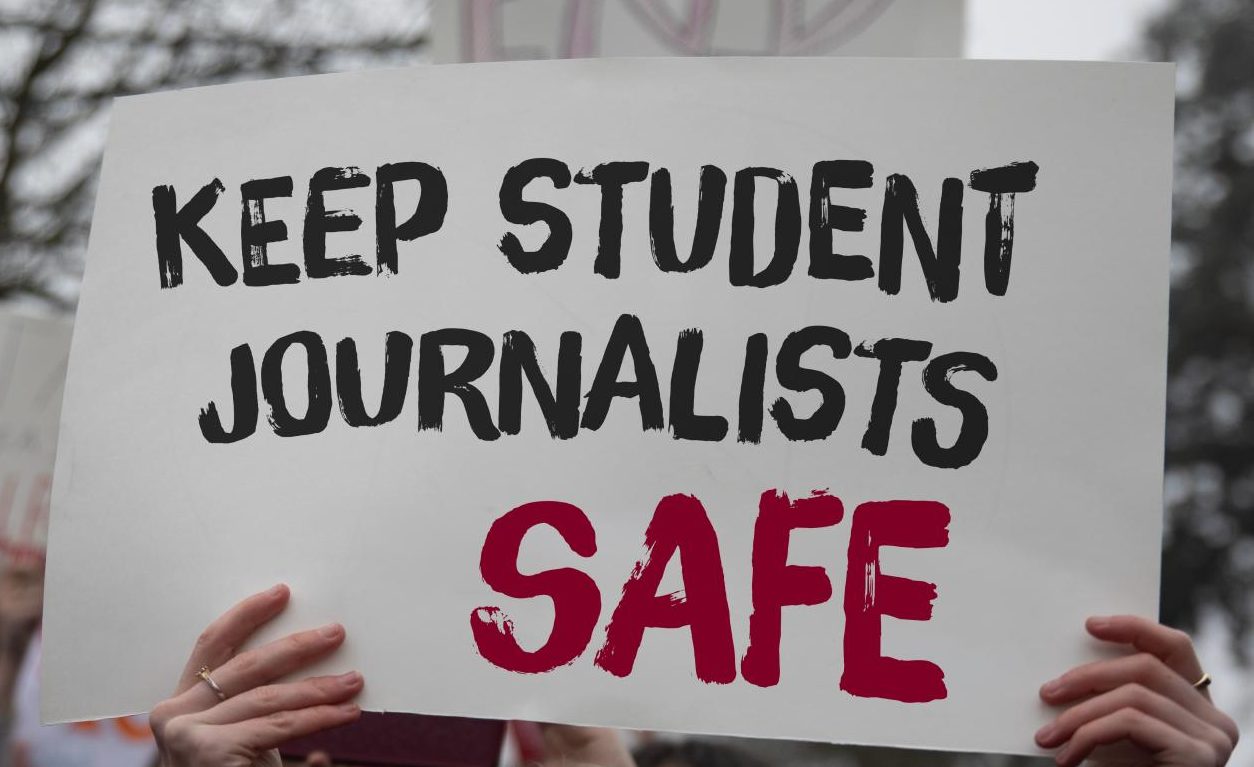
“Student journalism matters now more than ever,” Campbell said. “Events like the JEA/NSPA High School Convention offer you access to a network of support and resources that not only help you understand broader social and political tensions in new ways, but help you develop the skills to report on them responsibly, ethically, and safely.”
Building on that emphasis, organizers are highlighting additional educational opportunities and real-world journalism resources that will be available at this year’s NHSJC.
“I could talk about the Student Press Law Center pre-convention workshop, daily sessions, and resource booth all day,” Campbell said. “In Minneapolis, in particular, we also have knowledge to share from the Minnesota Star Tribune and their award-winning journalism covering George Floyd, [and] the Hubbard School at the University of Minnesota, which will host a series of webinars Feb. 23 that cover everything from the role of the photojournalist when everyone is recording to how to produce community journalism when ICE is in the community. We’re working on a special strand right now to have this be a focus this spring.”
Alongside these wide learning experiences, convention leaders are also emphasizing the priority placed on attendee safety.
“Rest assured, your safety is our number one priority,” Widmer said. “I will provide every adviser [with] my cell phone number, and if they feel it necessary, it can be passed on to students.”
Beyond logistical reassurances, convention organizers continue to stress the value of the student perspective in reporting on complex societal issues.
“As high school students, you are experiencing this in a way that is remarkable and extraordinary—and different from how the adults in your life, your legislators and others experience it,” Campbell said. “Your perspective needs to be part of the reporting. The level of professionalism it demands from you is notable. But the ways in which you plan for situational awareness, for care of sources in policy and practice, for inclusive and multifaceted reporting that holds people in power to account, and how you take care of each other. You’re the silver lining. You’re the hope.”
![MORE THAN A GAME. With two diving catches in the outfield, the Lions showed up defensively, aiding in their victory over the Pacers. One catch was made by Atwood, and the other by McGraw. Throughout the game, the Lions knew that it wasn’t just about their victory today. “I think [playing for cancer] makes it bigger than just a game,” McGraw said. “Knowing that you have a bigger impact in this world than just who you are as one person.”](https://wlhsnow.com/wp-content/uploads/2026/05/I70A1454-1-1200x800.jpg)