














![MORE THAN A GAME. With two diving catches in the outfield, the Lions showed up defensively, aiding in their victory over the Pacers. One catch was made by Atwood, and the other by McGraw. Throughout the game, the Lions knew that it wasn’t just about their victory today. “I think [playing for cancer] makes it bigger than just a game,” McGraw said. “Knowing that you have a bigger impact in this world than just who you are as one person.”](https://wlhsnow.com/wp-content/uploads/2026/05/I70A1454-1-1200x800.jpg)

















![Students in the National Art Honor Society work on the Mount Hood mural on the window of SouthLake Church. The students brought a variety of paints and mixed their own custom colors. “Instead of brushstrokes, we’re doing more dabbing, because it gives [a] better impression of tree foliage, rather than looking like actual brush strokes, because if we’re painting trees, we need it to look like trees,” Crawford said.](https://wlhsnow.com/wp-content/uploads/2025/10/IMG_2397-1200x900.jpg)





Like every sport, an environment is required for a safe and proficient playing experience. Whether it’s an arena, field, or backyard, each sport relies on a specific setting and can’t be played everywhere. For skiing and snowboarding, that is no different.
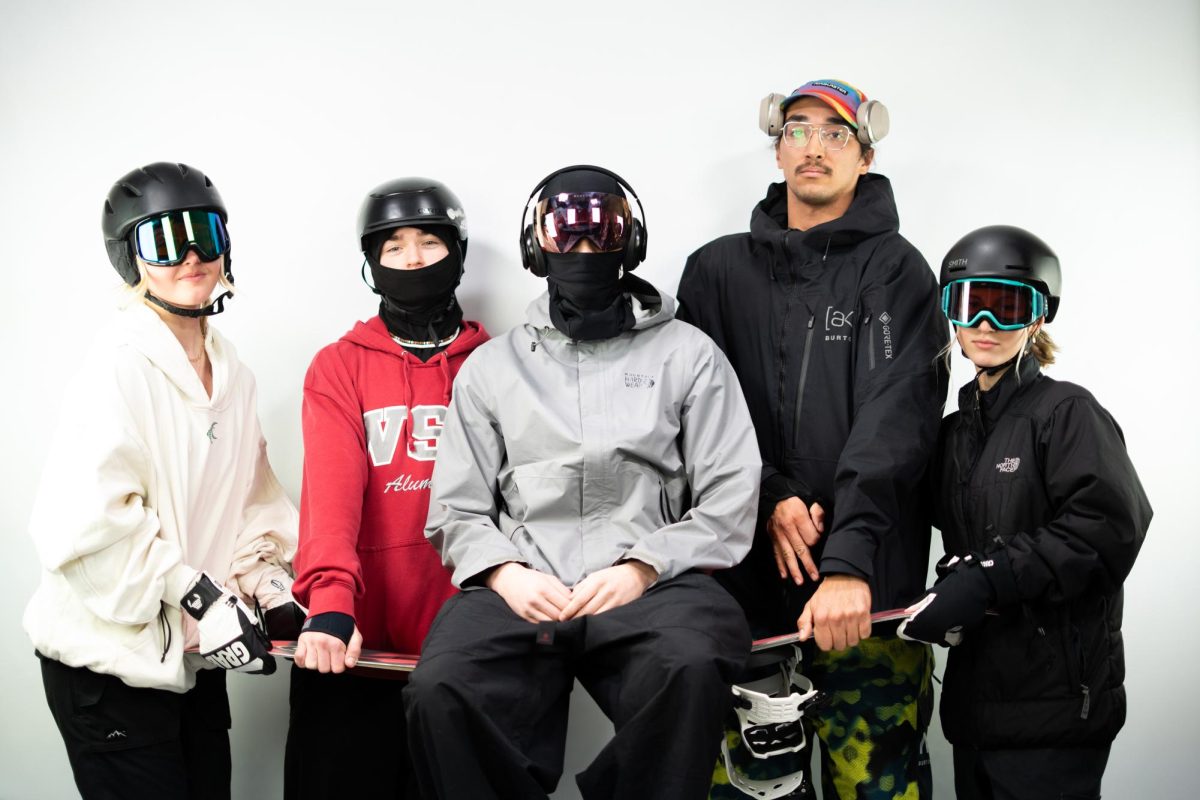
For many years, both teams have practiced and competed at Mount Hood. However, throughout the 2025-26 season, the snow being produced on the mountain has not been suitable for either team. As such, they’ve been having to move the season back, hopefully to a time with better snow. Marshall Susany, freshman, has been on the ski team since he was in eighth grade and is finding the lack of snow to be problematic.
“I think it really sucks, because a big part of high school [skiing] is no one’s trying to be super competitive,” Susany said. “When we don’t have snow, that handicaps a lot of what we do, and then a lot of people don’t have fun with it. And that just ruins the purpose of high school racing.”
Currently, there isn’t much of an alternative to postponing events, as other nearby mountains have the same problem. Megan Mandel, science teacher, teaches Advanced Placement (AP) Environmental Science, a course covering, among other environmental issues, the effects of climate change.
“The snowpack has been bad in other areas as well,” Mandel said. “If you go to Mount Bachelor in the Bend area, the snow conditions are also pretty horrible. [We’re] definitely seeing similar trends throughout the Pacific Northwest.”
Monika Jozic, senior, who has been on the snowboarding team all of high school and helped them win state in 2023, is viewing this as a negative.
“We’ve been having to move around a lot of practices, and we’ve had to miss competitions because of it. Now we’re even nervous if we’ll get state,” Jozic said.
Both mens and womens teams practice at Mount Hood Meadows, typically on Wednesday nights. But, due to the lesser amount of snow, the slopes started closing at night because of how the snow freezes. Kelan Goodrich, senior, has been on the ski team for all four years of high school.
“We would [go] for night training, but we haven’t been able to go there,” Goodrich said. “They changed their hours, so they’re only open from three to 10:00 at night. That’s instead of the usual morning hours [of 9 a.m. to 9 p.m.] with it, so it’s a little different.”
Jason Peterson, snowboarding head coach, has been the coach since 2011, and is becoming the president of the Oregon Interscholastic Snowboarding Association next season.
“This is a particularly bad year. The last time we had this little snow was 2014,” Peterson said. “It creates a lot of challenges in that there’s way less terrain for us to practice on. We have to get very creative with practices. Normally, we’re used to having enough snow, or we could have jumps built for us. We can have the whole mountain at our disposal to train and practice certain skills on. And when the season is like this, the whole game plan is scrapped. So, as coaches, [we have to] come up with different ways to train and demonstrate the same sorts of skills, or work on different skills altogether, knowing that we can’t do these other things. For example, we don’t have a half pipe, and yet we have a [half pipe] competition that we have to train for. That creates a lot of challenges for us.”
Emery Jackson, senior, started snowboarding as a freshman and sees a positive in the situation, despite the challenges.
“My board has definitely been getting really banged up, just from not [having] enough snow,” Jackson said. “I’ve gotten so many scratches and stuff, but I feel like I can try more things because the snow is a little bit softer, so it’s more forgiving.”
As a coach, Peterson has to manage both the mens and womens snowboarding teams, consisting of around 35 student-athletes total, where both teams will practice at the same time.
“It creates a lot of stress on the kids as well as the coaches,” Peterson said. “Fortunately, we have a pretty amazing team, and everyone’s come together really well. As challenging as it’s been, having less terrain to practice on has actually gotten the team a lot closer together because we’re condensed in a small area on the mountain. Now it actually becomes way easier for me as a coach and our other coaching staff to find kids and ride with them and train them.”
According to Capital Press, between 1991 and 2020, the median for the state’s snow-water equivalent, which measures the amount of water in the snow, was 50%, with several regions hovering around 25%. This means that by 2050, snow accumulation in Oregon is expected to drop about 25% or more.
Most recently, the northwest of the United States has seen the sixth warmest August, the warmest September on record, and the second warmest November over the last 130 years of recording. Despite snowstorms every couple of years, it’s reported to not be enough to bring Oregon back to regular snowpacks.
“When you’re talking about climate change with how diverse the impacts can be, you’d expect to see a bit more news on it,” Mandel said. “Peak snow melt is already happening one to three weeks earlier than it did in the 1980s and also longer dry spells. With climate change, we don’t necessarily see more frequent natural disasters, but we see more intense ones.”
With the level of change seen this season, it’s no guarantee if mountain snowfall will get better or worse the following year. Next season, Peterson will be in charge of the scheduling for the team’s practices and the league’s races.
“When we have to switch competitions or move them, it means that we may have been practicing something for a competition that we’re now not having this week. That creates a lot of stress for coaches, the riders, and it ultimately means our competitions aren’t as good,” Peterson said. “We’re [a] competitive team, but we’re also a developmental team. There are a lot of riders who need practice to feel confident going into competition, and if they don’t get it, unfortunately, they may just say, ‘I’m not going to compete because I don’t feel ready.’ As coaches, we don’t want to see that. I want my kids to participate, but I also want them to do so in a way that’s safe and where they feel that they’re able to demonstrate their skill set properly. And unfortunately, there’ve been several instances this year where we’ve had enough kids [who] don’t compete where it affects the competitive nature of the sport.”
Because of the influx of races being moved, Goodrich believes that the days will only get busier.
“February is already such a busy month, and it’s gonna be even busier now,” Goodrich said. “[We’ll] probably [have] double header race weekends. We’re gonna have to start going on Fridays [and] it’s gonna affect missing school as well.”
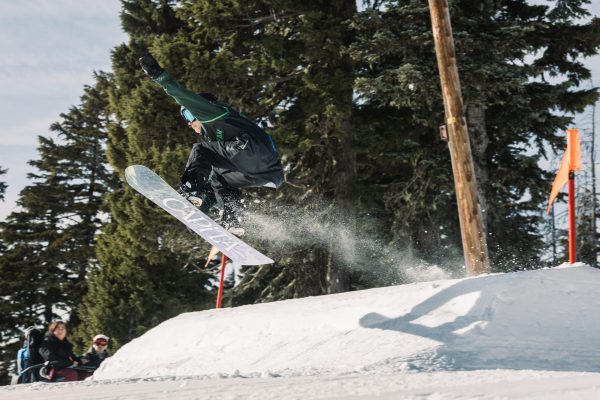
Ryder Fox, junior, has been on the team for three years and is one of the team’s slopestyle riders. Slopestyle is a race that requires tricks on things like jumps, rails, and boxes.
“[The lack of snow has] been making it a lot harder to try new tricks,” Fox said. “A lot of jump tricks make it really hard to have traction with the snow and confidence, because with falling, it usually feels a lot more like concrete and ice rather than soft powder.”
With President Donald Trump and the United States Environmental Protection Agency planning on eliminating a 2009 finding to help combat climate change, the future of the mountain’s snow availability is becoming more unclear.
“We’re going to likely see our snow season get shorter and shorter,” Mandel said. “More of that snow is likely going to fall as rain, which doesn’t make great conditions for the mountains either. With climate [change], we have to look at the big picture. That doesn’t mean that next year is going to be just as bad as this year, not necessarily at all. We could have several more years that are much better than this, but we will see more and more years that are like this.”
For now, both teams will continue through their respective seasons, with the state competitions for snowboarding occurring from March 10-14, and skiing from March 4-6.
“We’re hoping that the weather gets better next year,” Fox said. “Usually the weather will fluctuate, and it hopefully improves for next season or in the later months.”