










![MORE THAN A GAME. With two diving catches in the outfield, the Lions showed up defensively, aiding in their victory over the Pacers. One catch was made by Atwood, and the other by McGraw. Throughout the game, the Lions knew that it wasn’t just about their victory today. “I think [playing for cancer] makes it bigger than just a game,” McGraw said. “Knowing that you have a bigger impact in this world than just who you are as one person.”](https://wlhsnow.com/wp-content/uploads/2026/05/I70A1454-1-1200x800.jpg)









![Students in the National Art Honor Society work on the Mount Hood mural on the window of SouthLake Church. The students brought a variety of paints and mixed their own custom colors. “Instead of brushstrokes, we’re doing more dabbing, because it gives [a] better impression of tree foliage, rather than looking like actual brush strokes, because if we’re painting trees, we need it to look like trees,” Crawford said.](https://wlhsnow.com/wp-content/uploads/2025/10/IMG_2397-1200x900.jpg)



*WEB CONTINUATION: This article originally appeared in Volume 106 Issue 1 of our news magazine, Amplifier.
The Wicked Witch of the West has undergone significant evolution throughout her appearances in media. From the original “The Wizard of Oz” by Frank L. Baum to the movie of the same name, to a feature into her life in “The Wicked Years” series by Gregory Maguire, to the Broadway production of “Wicked,” this iconic witch has become a symbol of transformation as each iteration explores new variations of her story.
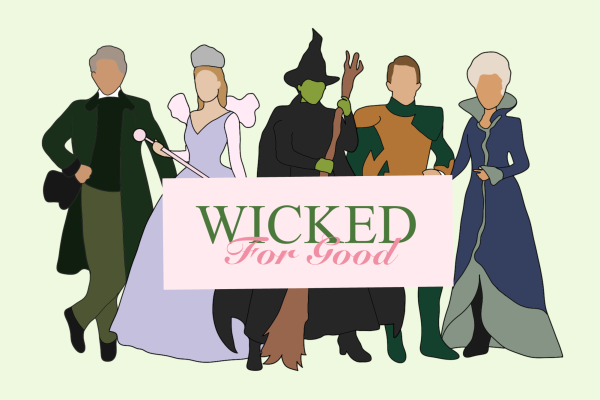
With the release of “Wicked: For Good,” this witch added another stripe to her pointy cap. Though based directly on the Broadway musical, “Wicked: For Good” enhances the original story, providing more in-depth details and new music while remaining true to its roots. There is, after all, no place like home.
“Wicked: For Good” covers Act Two material from the original Broadway production, with the story picking up a year after the ending of the first movie, “Wicked.” Elphaba has fully assumed her role as the Wicked Witch, with all of Oz against her, while Glinda, Fiyero, and Madame Morrible have been elevated to high public positions under The Wizard, and are beloved by the people, immediately setting up the conflict of this movie: perceived good versus perceived evil.
Right as the film begins, viewers familiar with the play will notice a brand-new scene, immediately sending the message that things are going to be different this time around.
And indeed, this first scene is not the only new one. Notably, two scenes accompany the new songs, “No Place Like Home” and “The Girl in the Bubble,” created by Stephen Schwartz, the composer and lyricist for the musical.
When hearing that there was going to be new music for the movie, I was excited, but hesitant. I was apprehensive that the music would feel out of place in the soundtrack, having been added in later. Schwartz wrote the pieces specifically for “Wicked: For Good,” and for the voices of Cynthia Erivo, playing Elphaba, and Ariana Grande, playing Glinda.
I was overjoyed to realize that these pieces fit in seamlessly and have, in fact, become some of my favorites of the soundtrack. The lyrics and context of both songs build depth for the characters singing them, adding much-needed revelations and insights into the characters.
The original songs of the musical are also enhanced in both of the movie adaptations, with access to a grander orchestra making for richer sound and a deeply immersive experience in the world of Oz. This is especially true for “No Good Deed,” where the intense instrumentals and amazing vocals by Erivo have quickly cemented it as one of my favorite songs from both movies.
“The Girl in the Bubble,” which has had multiple nominations for Best Original Song by movie awards shows, is the hallmark of one major change from musical to movie: Glinda’s character arc.
While Glinda does undergo a significant change in the musical through her friendship with Elphaba, it’s elevated in the movie to the point where viewers can truly see the moment reality sets in, and she finally understands the weight and the cost of the responsibility left to her. While the scene for “The Girl in the Bubble” is rather boring, it was an important turning point in Glinda’s development, a welcome addition that wasn’t fully realized in the musical.
The movie even took advantage of additional run time to tie up a loose end with the world’s magic system and Glinda’s place in it, giving more direction to the story’s ending. However, the audience was still left with plenty of questions, just like the musical. In fact, both of the movies generally gave the story more direction and eliminated some plot holes without imposing drastic changes.
With the extended opening and added scenes, “Wicked: For Good” is longer than the musical, and it feels like it. The first couple of scenes and songs go by slowly, but as the climax begins rolling, the final hour and a half of the movie flies by.
When comparing Act Two of the musical and “Wicked: For Good,” the musical came across as far darker than the movie did. Perhaps it was the set and costume design or the movie’s slower pace that gave events more room to breathe, but the movie lost some of the darker feeling that originally separated Act Two from Act One.
As the stars of the show, Erivo and Grande had performances full of emotion. From their singing voices to their movements and expressions, they embodied the characters in a way that truly convinced audiences of their knowledge of the characters. Elphaba and Glinda felt full and fleshed out in the movie, their motivations plain and widely appealing, but still exciting for long-time fans.
Notably, the entire cast had excellent portrayals of the characters, also pouring great emotion into their performances with every look and lyric.
Adding even further to this worldbuilding were the set and costumes. Even little things in the set, down to the posters decorating Elphaba’s hideaway, expand upon the characters and their world, taking advantage of the things audiences can see on the big screen that they couldn’t in the theater. The majority of the set was not created through post-production effects, unlike many blockbusters today; the studio actually planted nine million tulips to recreate Munchkinland, and built a functioning locomotive to carry Elphaba and Glinda to the Emerald City. The costumes follow this same principle, building further the image and evolution of every one of these characters. In short, the behind-the-scenes crew succeeded in bringing the world to life in a way that felt authentic and true to all past iterations of The Wicked Witch’s story.
It’s plain to see that Director Jon M. Chu chose a passionate cast and crew, which is exactly what the films needed: people who cared about the story and wanted to see it realized on the big screen.
The movies paid dividends, too, with “Wicked: For Good” worldwide grossing $518 million and “Wicked” grossing $758 million, not to mention the number of brand deals associated with both movies. It’s safe to say that audiences enjoyed both films as well, as “Wicked: For Good” earned a 93% from audiences and “Wicked” earned a 95%.
While “Wicked: For Good” was less critically acclaimed than its predecessor, with only a 66% from critics on Rotten Tomatoes compared to “Wicked”’s 88%, it brought the same heart with its performances, and welcome changes compared to the musical. While it didn’t clarify everything and progressed more slowly than its Broadway counterpart, the movie brought new life to the story, cementing the characters and world in the hearts of the audience for good.
Which "Wicked: For Good" character are you?
There was an error. Please try again.
6 Total Questions
