












![MORE THAN A GAME. With two diving catches in the outfield, the Lions showed up defensively, aiding in their victory over the Pacers. One catch was made by Atwood, and the other by McGraw. Throughout the game, the Lions knew that it wasn’t just about their victory today. “I think [playing for cancer] makes it bigger than just a game,” McGraw said. “Knowing that you have a bigger impact in this world than just who you are as one person.”](https://wlhsnow.com/wp-content/uploads/2026/05/I70A1454-1-1200x800.jpg)
















![Students in the National Art Honor Society work on the Mount Hood mural on the window of SouthLake Church. The students brought a variety of paints and mixed their own custom colors. “Instead of brushstrokes, we’re doing more dabbing, because it gives [a] better impression of tree foliage, rather than looking like actual brush strokes, because if we’re painting trees, we need it to look like trees,” Crawford said.](https://wlhsnow.com/wp-content/uploads/2025/10/IMG_2397-1200x900.jpg)



*WEB CONTINUATION: This article originally appeared in Volume 106 Issue 1 of our news magazine, Amplifier.
If Bellagio’s Pizza wanted to give a teacher $500 to wear a Bellagio’s T-shirt 10 times throughout the school year, should they be allowed to do that? This is the sort of topic breached in discussions in Advanced Placement Literature and Composition (AP Lit).
AP Lit is one of the two AP English classes offered at the high school, and only seniors are allowed to enroll in it. The class focuses on reading, analyzing, and writing about imaginative literature. Andy West, AP Lit teacher, has been teaching high school students for 30 years.
“AP Lit is selective, the students who take the class have willingly expressed an interest, and I take that as a reasonable assumption that they want to be here,” West said. “The class is all literature. It’s 40% short stories, 40% poetry, and 20% what the College Board calls longer works.”
Some examples of these longer works include the play “Macbeth” by William Shakespeare, the novel “Sula” by Toni Morrison, the short story “The Things They Carried” by Tim O’Brien, and the poems “The Wanted Child” by Sharon Olds, and “The City Limits” by A.R. Ammons.
Sahara Leeser, senior, enjoys writing in her free time which got her interested in the AP English programs.
“It’s been a really fun class. I had some senior friends who took it before, and they briefed [me] on it, and they made it seem like it was going to be terrifying,” Leeser said.
At the beginning of this school year Governor Tina Kotek enacted Executive order 25-09, a phone ban in Oregon schools. Reasons cited for this order include better mental well-being, improved educational outcomes, and school safety.
“For most of my career, I’ve taught upper class people,” West said. “I had years of experience before social media, before cell phones, and that gave me a vantage point to see the detrimental effect of social media on students: students got more and more quiet and more and more hesitant to talk.”
Social media is proven to harm teenage mental health—according to the Oregon government, one in five teens report social media sites hurt their mental health. This can translate to the classroom as well—feeling as if you belong in your school community and classrooms can improve teens’ mental health and behavior, according to Taylor & Francis online.
“My next response to the way in which students got quiet was to try to fill the void myself,” West said. “Over time, what I noticed was when I pointed out things in a text, it actually had the unintended consequence of making some students get more quiet.”
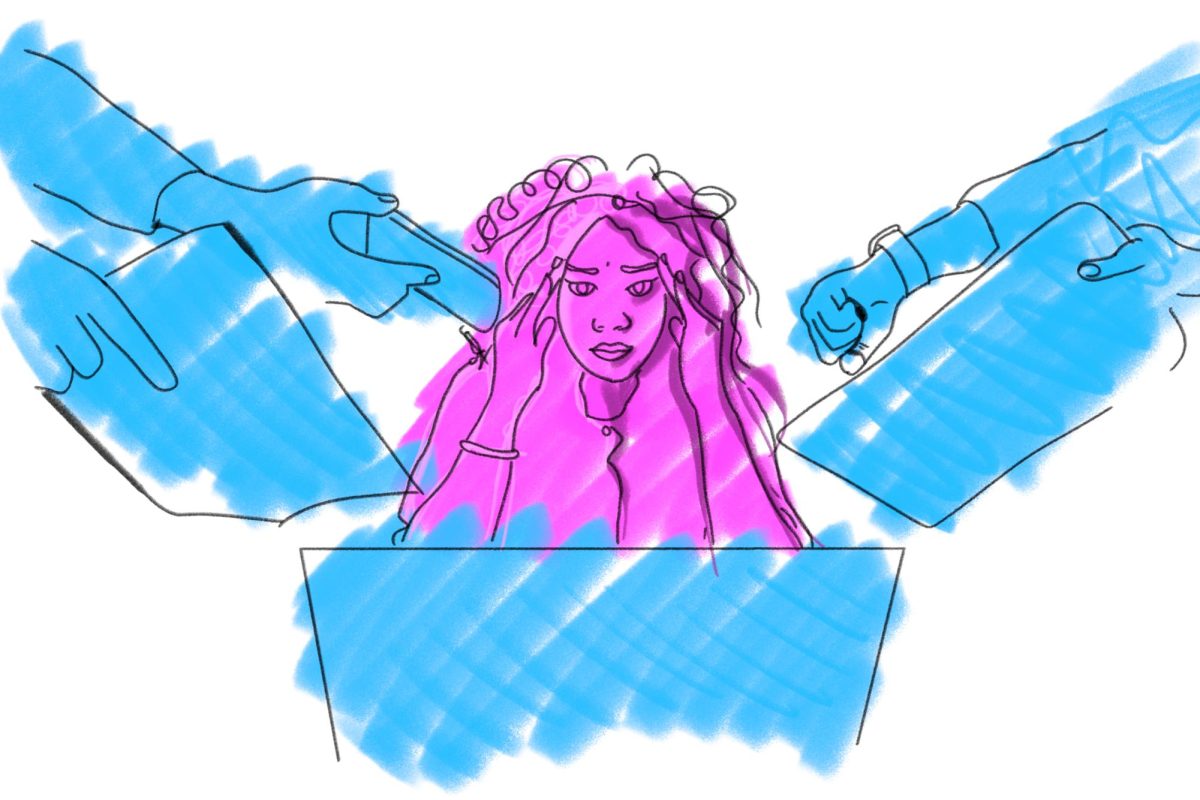
The solution to this problem? Something to help students feel comfortable talking in class. That’s how A Random Minute (ARM) came to be.
“I started on the very first day of senior English with a slideshow saying, ‘this is what ARM is. This is the context. This is the way in which students have stopped talking. This is Governor Tina Kotek. This is the new rule, or executive order saying that there’s no cell phones. We’re going to try a random minute. So who has a topic to discuss?’” West said. “So less than five minutes in the class on the very first day, I stopped talking and said, ‘who’s got a comment?’ And went from there, and it’s been really successful.”
Ciaran DeYoung, senior, is taking AP Lit this year.
“My slight worry [about ARM] was just that it does take away from class time that can be spent on other things,” DeYoung said. “But as the year goes on, I have seen that it is very useful, it gives an opportunity to talk and have a break in class time [to] get used to discussion without having to jump into super detailed heavy topics.”
Class discussions help students think critically, gives them a sense of community, and can prepare students for deeper or heavier topics. Discussions like ARM create a light environment for students to participate, making it easier for them to feel more comfortable participating in heavier discussions later on.
“We can debate, and we can argue, and we can say, ‘what, are you kidding?’ and all those things, and it’s totally safe. And because it’s safe, students are willing to talk,” West said. “My goal is to build community on topics that you can’t get wrong, and hope that the momentum that we’ve established early will carry on into the academic discussion.”
As we approach the second semester of the school year, the benefits from this policy can be seen.
“I am not the most talkative,” Leeser said. “So I thought [ARM] was gonna be a little bit weird, but I actually like it, it did help me feel more comfortable talking to [my peers]. Because instead of just being strangers, I felt like it connected us all. It connects you outside just your singular classroom as well. Even with other people, we can talk about AP Lit and our random minutes in our different class periods.”
These ARM discussions cover a wide range of topics, such as the best type of cheese, what makes a sandwich a sandwich, and whether or not teachers should be allowed to accept sponsorships. These random minutes give students levity in their day, provide connection points with their teacher as well as other students, and help prepare for actual class discussions.
“There’s a lot of laughter, there’s a lot of smiles. There’s been serious topics, frivolous topics, really idiosyncratic topics. It’s been very beneficial to building community and trust,” West said.
