






















![MORE THAN A GAME. With two diving catches in the outfield, the Lions showed up defensively, aiding in their victory over the Pacers. One catch was made by Atwood, and the other by McGraw. Throughout the game, the Lions knew that it wasn’t just about their victory today. “I think [playing for cancer] makes it bigger than just a game,” McGraw said. “Knowing that you have a bigger impact in this world than just who you are as one person.”](https://wlhsnow.com/wp-content/uploads/2026/05/I70A1454-1-1200x800.jpg)





















![Students in the National Art Honor Society work on the Mount Hood mural on the window of SouthLake Church. The students brought a variety of paints and mixed their own custom colors. “Instead of brushstrokes, we’re doing more dabbing, because it gives [a] better impression of tree foliage, rather than looking like actual brush strokes, because if we’re painting trees, we need it to look like trees,” Crawford said.](https://wlhsnow.com/wp-content/uploads/2025/10/IMG_2397-1200x900.jpg)



*Disclaimer: this article has mentions of sexual assault. Viewer discretion is advised.
Three years ago, Kendrick Lamar released his fifth studio album, “Mr. Morale & The Big Steppers,” (also known as “Mr. Morale”) which was an exploration of Lamar’s psyche, past, and relationships with other people, all told in the perspective of a therapy session.
While the album came out to a great amount of critical acclaim, winning three Grammys for Best Rap Album, Best Rap Song for “The Heart Part 5,” and Best Rap Performance, the initial fan reception was much more negative, with many criticizing it for being lengthy, slower paced, and its controversial use of Kodak Black, a rapper accused of sexual assault, on an album that repeatedly talked about how sexual assault affects people in the black community.
The high expectations for the album were likely another major factor in its negative reception. The album came after a five-year hiatus from releasing “DAMN.,” an album that spent over 400 consecutive weeks on the Billboard Hot 200 and won Lamar a Pulitzer Prize, the first rap album ever to do so. Many believed that Lamar had retired from making music at that point.
A week before releasing “Mr. Morale,” Lamar released “The Heart Part 5,” a jazzy, fast-paced rap that sampled Marvin Gaye’s “I Want You.” While the themes on “The Heart Part 5” were pretty consistent with what would be talked about on “Mr. Morale,” sonically, the album would diverge from the single, ending up sounding far slower and emotional, which may have also contributed to fans’ initial unfavorable response.
Many fans found the change in tone and sound jarring. One student publication in Minnesota, The Echo, wrote an article that called it “monotone” and “mediocre,” saying that, though it had high points, a lot of it was boring and sounded the same. One student from West Linn in particular, Ilay Field, junior, had an interesting first listen to the album.
“I personally argue that this is Kendrick’s most experimental record,” Field said. “I was really caught off guard, especially at the beginning [with] ‘United in Grief’ with all of these different compositions woven into the song [that] contained a lot of beat switches. For me, somebody who’s mainly just played violin and always stuck in with one singular instrumentation, it was a bit difficult to process throughout the entire album, especially with songs like ‘We Cry Together,’ ‘Crown,’ ‘Silent Hill,’ ‘Savior,’ ‘Auntie Diaries,’ and ‘Mother I Sober.’ Those [were] a bit more jagged than what I was used to.”
In comparison to some of Lamar’s prior albums, Field finds the concept and execution of “Mr. Morale” to be a new experience.
“The amount of detail throughout the entire record, the concept of it as well, that’s what blew me away,” Field said. “The first time I recognized it and found out, I went through every single song, every single lyric, and connected them with each other. It isn’t a straightforward story, similar to ‘good kid, m.A.A.d city,’ but in a way, I feel like it conveys more emotion, and it also adds into a bunch of world building with [the] record, which is surprising, because with ‘good kid, m.A.A.d city,’ it’s just [a] straightforward depiction of his childhood, yet I thought that this was a stronger form to display his emotions.”
Not only has “Mr. Morale” had an impact on its listeners, it has also impacted the hip hop game, helping spawn a more vulnerable era of rap. This can be seen most prominently in how the album impacted Tyler, The Creator and his 2024 album “Chromakopia.”
Since its release, Tyler, The Creator has been praising “Mr. Morale” for its vulnerability and honesty.
“[The album is] so open and honest that some people can’t listen to it,” Tyler, The Creator said in a Converse All Stars Series panel. “They probably feel like he’s looking at them in their eyes. And they’re like ‘Uhh, I can’t panic, I can’t listen to this.’”
When “Chromakopia” was released, an album that was considered the most vulnerable in Tyler, The Creator’s discography, the comparison was easy to draw between it and Lamar’s “Mr. Morale.” The album covered similar topics as “Mr. Morale,” such as commitment issues, racial generational trauma, and family relationships.
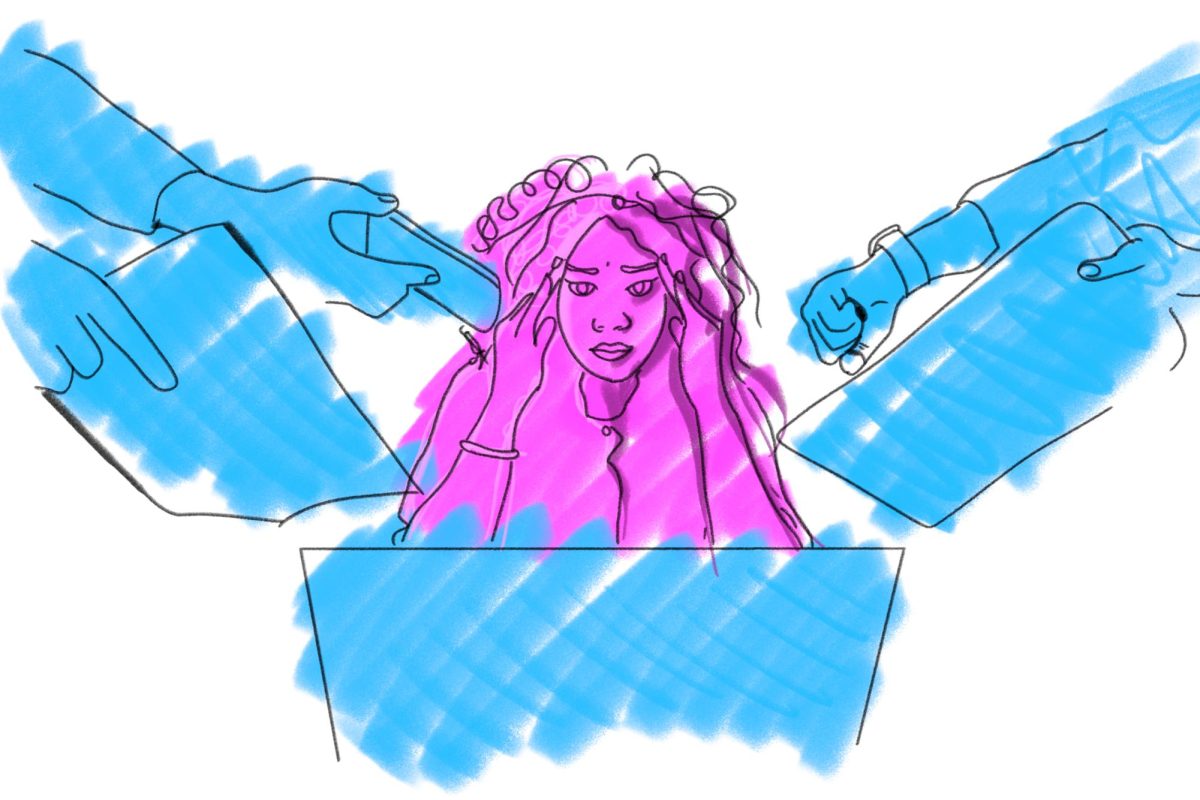
Graphic by Garrett Arendt.
“Whether it be music or having a family, continuing on a path that he does not understand, I can see how an album like ‘Mr. Morale’ can heavily affect how he perceives himself, because ‘Chromakopia’ [is] Tyler’s most humane album,” Field said. “I’d say it’s one that doesn’t really contain a big story compared to others. However, it has a lot of ideas that are extremely intertwined with Tyler’s character and perception of reality.”
A rapper telling their truth has always been a major part of rap, but the true honesty shown in “Mr. Morale” is a rare specialty, and will hopefully inspire other rappers to do similarly in the future, like it has with Tyler, The Creator.
“When it comes to records that are so so personal, like ‘Mr. Morale,’ I think [they] contain a real strong substance that will maintain the musicians’ character long after their death, which I think is really interesting,” Field said.
For the album as a whole, each song plays its own role in conveying the story from start to finish, even if some aren’t as phonetically similar.
The album starts off with “United In Grief,” an introduction to Lamar and his situation of being forced into therapy. It and the second song, “N95,” go into how he views himself against the world and his hypocrisy. In “United In Grief,” Lamar conveys how jewelry shows his maturity, while “N95” shows overcompensation for his low self-worth.
The therapy sessions continue as he begins to express the issues in his relationship with his father as the listener goes into “Father Time.” Despite his becoming more open in expressing his personal issues, we can see he still has trouble acknowledging the root of these issues. At the beginning of the song, Lamar’s wife, Whitney Alford, tells him that he needs therapy before Lamar responds, saying a “real man” doesn’t need it.
Even though he can express how hard his father was on him, Lamar still blames himself for these issues and says that his father’s actions are what made him the man he is today, so he feels he has to be okay with what has happened to him.
Continuing through the story, the album moves onto “We Cry Together,” a track that feels more like an argument rather than a song. Featuring Taylour Paige, the song portrays the two in an emotionally abusive relationship, with the two going back and forth in a heated argument before ending with sexual reconciliation. It shows the way that the problems in Lamar’s self are also hurting his relationship with his wife.
The song “Count Me Out,” placed at the start of the second half, is the turning point of the album, where therapy starts to influence him. Though he was already relatively vulnerable from the beginning of the album, this is the point where he starts to truly open up about his past and stops making excuses for his own actions as well as the actions of others toward him.
After this turning point, Lamar gives an emotional performance on “Crown” as he raps about how his mistakes in his relationship may have hurt his wife so much that it’s irreversible. He learns to accept that fact and take ownership of his mistakes, and acknowledges that if his wife decides to leave, he has to accept that.
On “Silent Hill,” Lamar talks about how, due to his therapy, he is learning to push off the people and influences that have caused him to make mistakes and hurt people in the past.
Lamar faced controversy for the songs “Rich” and “Silent Hill” because both feature Kodak Black, an artist with accusations of sexual assault from 2016, as well as an overall controversial public image due to his arrest for that incident. Many initially saw putting Kodak Black with these allegations on an album that will go on to talk about how sexual assault can truly hurt people as deaf to the situation, but Lamar’s choice seems to have aged better through the years.
Lamar uses Kodak Black as an example of how Lamar could have ended up without the help that he got. The album deals with how generational trauma in the black community causes people to hurt others, and Kodak Black is potentially being portrayed as a prime example of that. Though it is still arguable as to whether or not it was the right decision to include Kodak Black on this album, it has become clearer through the years that there was an intention behind the decision.
At this point, Lamar starts to consider the savior complex he has put onto himself through his music on the album “Savior.” He begins to realize that he can’t save everyone like he wanted to do on his previous, very politically conscious, albums. He is only able to work on himself and encourage others to do the same.
Accepting those for who they are is the main message of “Auntie Diaries.” The song tells the true story of Lamar’s uncle, who is transgender, and how he was heavily criticized and not accepted by his family. Alongside this, the song also tells the story of Lamar’s cousin, who is also transgender. The song grapples with Lamar’s struggles in adjusting to these changes and how his family influenced him, as well as going against his own religious beliefs to choose his family.
“Mother I Sober” is the most vulnerable Lamar gets on the entire album. The song itself tells the story of how his mom was sexually assaulted and how, later in life, his cousin was accused of sexually assaulting Lamar, despite not doing it. Even though Lamar tells them it’s not true, his mother doesn’t believe him because of the fear of what happened to her, leading to trust issues. The song ends with him breaking this generational cycle of trauma, refusing to put the trauma towards his kids.
The last song, “Mirror,” is used as a message of reflection that tells people to look back at themselves, similar to what Lamar has been doing throughout the album. His main message is for people to stop pushing their problems onto other people, especially onto public figures like him, whom they don’t even know.
Overall, “Mr. Morale” has been an album that can be looked back at as one of the most vulnerable and personal albums to date in any genre. Though many did not love it upon its release, it has gained more praise from fans over time, which can be seen through publications rereviewing the album after its release.
“Mr. Morale” is in no way perfect, but that’s exactly what the album intends. It’s not meant to be perfect, just as Lamar is not perfect, and he is not anyone’s savior. He is flawed, just like every listener of the album, like every human being.
Some may not deeply connect to the album’s themes, but the storytelling and vulnerability that Lamar does through each and every song on the album clearly shows why this album is so important for those that can connect to its themes, and those that will be able to connect with it as they go through life.
For the album itself, it is fully recommended that people listen if they have the chance, and enjoy the story of how Lamar became a better version of himself and continues to improve.



zach
Dec 1, 2025 at 12:59 pm
cool article