




















![MORE THAN A GAME. With two diving catches in the outfield, the Lions showed up defensively, aiding in their victory over the Pacers. One catch was made by Atwood, and the other by McGraw. Throughout the game, the Lions knew that it wasn’t just about their victory today. “I think [playing for cancer] makes it bigger than just a game,” McGraw said. “Knowing that you have a bigger impact in this world than just who you are as one person.”](https://wlhsnow.com/wp-content/uploads/2026/05/I70A1454-1-1200x800.jpg)



















![Students in the National Art Honor Society work on the Mount Hood mural on the window of SouthLake Church. The students brought a variety of paints and mixed their own custom colors. “Instead of brushstrokes, we’re doing more dabbing, because it gives [a] better impression of tree foliage, rather than looking like actual brush strokes, because if we’re painting trees, we need it to look like trees,” Crawford said.](https://wlhsnow.com/wp-content/uploads/2025/10/IMG_2397-1200x900.jpg)




The term “off and away all day” has been widely and commonly used to describe phone usage in public school classrooms, suggesting that students have their phones away at all times. However, as of recently, this term has become more concrete through the signing of Executive Order 25-09.
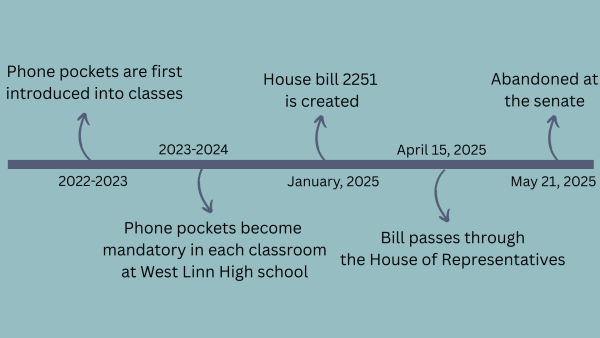
Before the signing of the Executive Order, there were plans for other phone restrictions dating back three years.
During the second semester of the 2022-2023 school year, science and language arts classes were the first to implement the phone pockets, where students would leave their phones for the remainder of the period. Once the 2023-2024 school year hit, the phone pockets stretched beyond those two subjects and were mandatory in every classroom, from history to math and even electives.
However, in January of this year, Oregon legislators created a bill to ban the usage of cell phones entirely in schools starting in the 2025-2026 school year. This eventually spread to 19 other states and started the process of getting passed.
As a staff, we do not agree with placing full restrictions on phone use in any school-related place or event.
The bill states that every district is required to enforce the phone policy and restrict the use of personal electronics on school grounds, at any school-sponsored activity, on school-provided transportation, or at any official school bus stop, and provide consequences if not followed.
The main goal of the bill is to help lower screen usage and allow for a better learning environment. This push to limit phone usage in schools is supported by research showing that smart phones can impact the overall focus of a student.
In a study done by the University of Chicago, nearly 800 smartphone users studied material and took a test. During this experiment, there were three groups: One group with their phones on the desk, one with their phones in a bag or their pocket, and one with their phones completely out of the room.
After the test was taken, those with their phones completely out of the room significantly outperformed those who had their phone on their desk in both working memory capacity and fluid intelligence, meaning that worrying about not using their phones negatively impacted the performance of those who could see them.
However, the negatives of phone use aren’t the whole story.
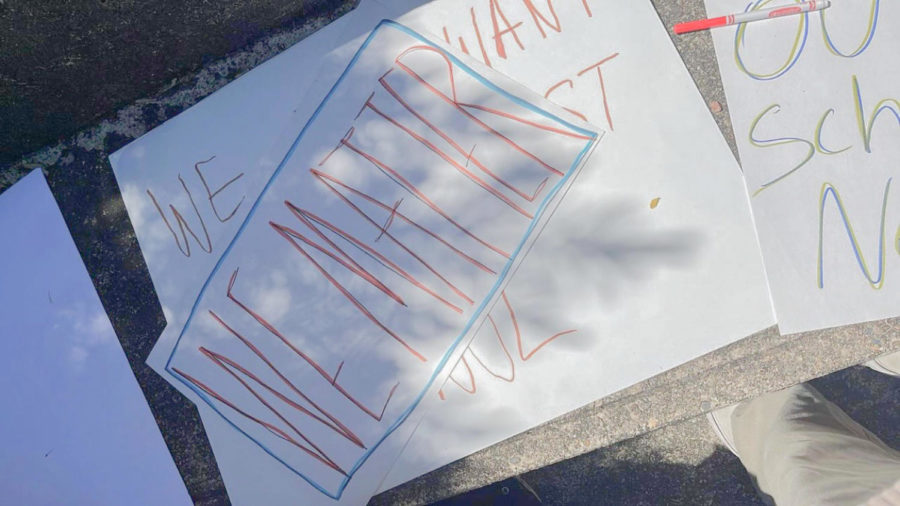
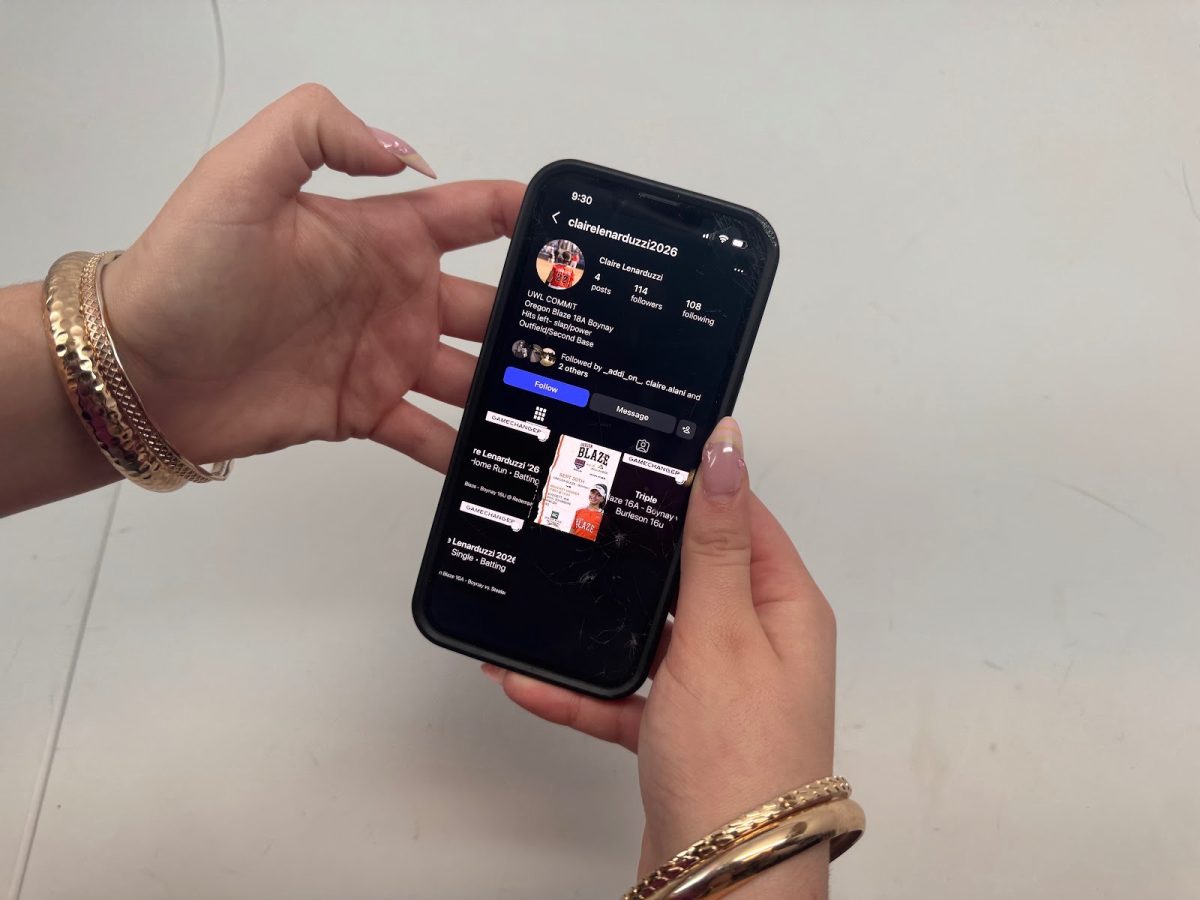
As journalists, we use our phones constantly, whether it’s to take a quick photo of an event or when we record a transcript of an interview for later reference. With the proposed stipulation that students cannot have their phones even for school events, this could mean we can’t bring our phones to school-sponsored sporting activities to conduct interviews or take photos while attending events like choir and band concerts.
During class time, we use our phones to send messages and emails to set up interviews, take that final photo to finish our stories, or even communicate with another reporter about their progress.
Not only is the policy harmful to journalism, but Blake Williams, the Associated Student Body (ASB) advisor, sees the phone policy as harmful to ASB, as well as other programs and clubs throughout the school. ASB communicated the policy through a video on the first block schedule day, and is currently still figuring out problems stemming from the phone ban.
“Our kids [are] simply going to leave campus at lunch just to go on their phones for 30 minutes, and now our beautiful, 70 robust clubs are going to shrivel?” Williams said. “We worked so hard last year really trying to make assemblies this unifying experience and fun and something you don’t want to miss, but is the addiction [to] phones going to be so great that [students] miss the assembly? There [are] a lot of problems including [the] Amazing Race. We communicate on our phones for safety, and each ASB member is supposed to text when certain people get to checkpoints or when someone gets hurt, and now we can’t use phones. ASB is now trying to think outside of the box.”
Another program heavily affected is the Robotics program. Ananya Ilanchelian, sophomore, has been on the team for two years and is the electrical lead for the team.
“It’ll definitely affect us, because we need our phones to interact with our parents, get rides, confirm whether we’ll be going to the meeting or not, and we also use Discord as our primary method of communication within the team. That’ll impede our ability to communicate,” Ilanchelian said. “I’d say the largest impact will be during our build season, which is after January. For eight weeks after that, we use Bolton Primary School to test our robot, because we have half of a playing field built there. So when the team is split between Bolton and West Linn, communication will be very difficult.”
These communication issues are one of the biggest factors contributing to our belief that there are better ways to enforce phone policies than what the bill suggests.
One of these ways is based on conduct. If a staff member deems that a student’s phone has become a problem, it could be taken away for the day, or, if necessary, harsher consequences could be imposed. This would make it up to the teacher, giving them as much or as little responsibility as they’d like.
This is just a suggestion, but ultimately, we want to be able to continue what we do in the classroom and keep reporting on events without the risk of our phones getting us in trouble.
We do agree that there has been inattentiveness. Students will do whatever it takes to get their phone back just to go on social media or check that last message. However, measures like the phone pockets are having a positive effect on classes such as language arts and math.
As journalists, we need access to our phones on school grounds, but as students, we may need them to contact family in case of an emergency. We know that there are exceptions for these reasons, but students may need to contact families over medical concerns sooner than going through the office, review timers for medication, or check in with family members for a variety of other reasons.
But we want them to know we’re safe, too.
Since the start of the 21st century, 646 school shootings have occurred across the country, with at least one incident in each state.
This goes beyond journalists. We students, despite the possible distractions, should have our phones with us. It’s more than just social media or text messaging; it’s about staying connected to family and friends and making sure we can let them know we are okay.
We acknowledge that having phones in our hands disrupts our class time, but to keep our phones, we’re willing to work in harmony with technology and find a solution that keeps us all learning, reporting, and safe.

Bobbie J Warner
Aug 28, 2025 at 8:53 pm
Have watch that only communicate to parents and school info allows only calls to register family member. You have paid for iPads why not watches. And leave phones at home altogether do your not responsible for the phones. Watches issued each year.