




















![MORE THAN A GAME. With two diving catches in the outfield, the Lions showed up defensively, aiding in their victory over the Pacers. One catch was made by Atwood, and the other by McGraw. Throughout the game, the Lions knew that it wasn’t just about their victory today. “I think [playing for cancer] makes it bigger than just a game,” McGraw said. “Knowing that you have a bigger impact in this world than just who you are as one person.”](https://wlhsnow.com/wp-content/uploads/2026/05/I70A1454-1-1200x800.jpg)




















![Students in the National Art Honor Society work on the Mount Hood mural on the window of SouthLake Church. The students brought a variety of paints and mixed their own custom colors. “Instead of brushstrokes, we’re doing more dabbing, because it gives [a] better impression of tree foliage, rather than looking like actual brush strokes, because if we’re painting trees, we need it to look like trees,” Crawford said.](https://wlhsnow.com/wp-content/uploads/2025/10/IMG_2397-1200x900.jpg)




For the first time in Oregon history, an executive order, signed on July 2, has banned students from using cell phones during school hours. Oregon Governor Tina Kotek authorized Executive Order 25-09, which applies to all K-12 public schools. The districts must implement a policy complying with the law by Oct. 31, and be in full effect by Jan. 1.
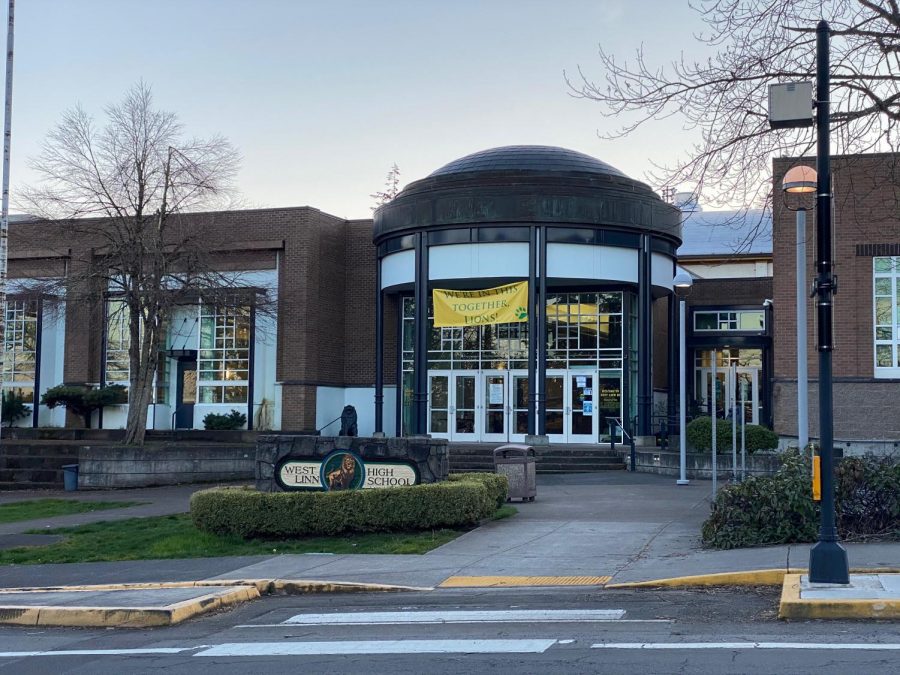
An email was sent to the West Linn-Wilsonville School District (WLWV) on Aug. 20, introducing the new “Off and Away All Day” policy. Information sent in an email from the district’s Communication Director, Andrew Kilstrom, explained that electronic devices, including AirPods, Apple Watches, and iPads, could be stored in a backpack, a locker, or left at home. It went on to share the expectations and regulations for student infractions.
According to the State of Oregon’s website, the law is intended to “[deliver] a high-quality public education and [protect] Oregon’s young learners’ safety, health, and wellbeing.”
Kyle Rumrey, history teacher, is entering his third year at West Linn High School and has taught Civics, world history, and Advanced Placement United States Government and Politics. Last year, all of the teachers were expected to have a phone pocket in their classrooms, but these have since been taken down.
“I think [last year’s system] gave teachers a lot of flexibility to design their own policy and run [classes] the way they felt comfortable with,” Rumrey said. “Some teachers used that to build relationships and establish culture in class, so I liked it.”
According to Education Week, 54% of United States students reported that they get distracted by peers using devices during class, and two-thirds claim to be inattentive when using a personal electronic device. Removing the option is intended to improve student attention spans and increase classwork completion.
“There has been a major shift in student behavior since the law,” Rumrey said. “It appears that students seem to be more engaged and participatory. I noticed that when I give my students something to work on, they seem to jump on it a little bit more enthusiastically. The classroom culture seems to be more stable as well.”
Currently, 34 states have enacted policies or laws on K-12 cell phone usage, and 26 of those have completely banned or limited devices, according to BallotPedia. Other states, such as Colorado and New Mexico, set guidelines for districts to follow, but have not legally enforced any actions.
“I think it’s really fascinating that it took systems and governments this long to be able to put something in place that’s strong and supported to mitigate the negative impacts phones or devices have on students,” Rumrey said. “It seems like it’s long overdue.”
On the first day of school, 40 personal electronic devices were confiscated, 21 on the second day, 19 on the third day, and 22 on the fourth day. Across the first three days, there were four repeat offenders. During the second week of school, a total of 65 devices were taken and 67 were confiscated the third week.
Saleen Chenevert, librarian at Athey Creek Middle School (ACMS), has interacted with students for 10 years, working as an admin assistant and in-house substitute teacher for the first seven years at ACMS.
“I absolutely think [the law] is a positive. I think it’s sad that we have to have a law for it, especially an emergency declaration of a law,” Chenevert said. “But, I think it’s a lot easier for administration and districts [because we] are being told [we] have to do it; our hands are tied. And, all the data says that if you are bored, you have a better chance of being creative, inspired, and motivated. I also think it’s important for staff and administration to also not be on their phones and be present for [students] as well—it has to be both ways.”
Outside of high school, middle schools are also adjusting to the law, but they are transitioning from a different system—last year, staff members would usually ask students to store their phones in their lockers, or give them to the front office if phone use became a repeated issue. There were no written policies or rules, like the phone pockets in high school. Additionally, the classroom expectations between teachers were inconsistent; some allowed students to access their phones, while others did not.
“[The old system] was hard because it was never treated as a hard and fast rule,” Chenevert said. “It wasn’t consistent with the punishments, and who got away with it [versus] who didn’t. There were lots of kids in the bathrooms with [phones] walking down the halls with them. So by the end of the year, you could just see that people were like, ‘I don’t want to fight this anymore’.”
Chenevert has been responsible for technology, literature, and curriculum in the library for the past three years. She participates in sixth-grade orientation, hosts classes that visit the library, checks out books, organizes book tastings, and more.
Currently, the policy applies to times outside of classes, such as passing periods or lunch. Students are encouraged to reach out to Kotek if they have questions or concerns.
“I think at the high school level, [having phones during] lunchtime would be very acceptable. High schoolers have jobs, sports, and clubs where people are planning trips and meetings,” Chenevert said. “[They] should have an opportunity to act in the business world like we act in the business world, where we can quickly make appointments and check in. I think [they] should be allowed to have a little bit more freedom. We can’t cut [them] off from everything all at once, then send [them] to college, where [they] have it all the time. I feel like if we do that, the pendulum is going to swing the other way, and we might make the addiction worse when [they] need to pay attention the most.”
Staff members received the same reminder emails, explaining the new policies, as the families in the district. For ACMS, the topic was mentioned in a staff meeting two days before school started, where they discussed consequences, and that policing was not necessary.
“The best part is the student engagement and interaction. Their heads aren’t down, they’re not on a phone,” Chenevert said. “We have some shy kids, and sometimes it’s nice to have the phone to distract you, but I feel like it inhibits people from reaching out to the shy kids. But this year we have a lot of new students, and I feel like they’re adapting faster, because more people are checking in. There’s more eye contact. Even the hallways are noisier, for good or for bad, because they’re talking and they’re in groups.”
Until Oct. 1, students may pick up their device from the office at the end of the school day if it is the first offense. After that date, or if it is a second offense, it must be picked up by a parent or guardian. For more information, visit the WLWV website.
“I definitely think in the long run it will improve student achievement and bring up the students who may not be as gifted as others in specific subjects,” Rumrey said.
